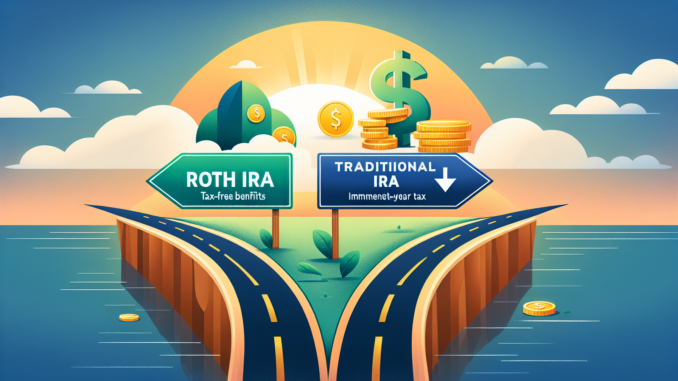
Roth IRA vs. Traditional IRA: Which Retirement Account Is Right for You in 2026?
Individual Retirement Accounts (IRAs) are among the most powerful tax-advantaged tools available to everyday retirement savers. Yet the most consequential decision — Roth or Traditional — trips up investors at every stage of life. Both account types share the same annual contribution limit and a broad universe of investable assets, but they differ fundamentally on when the IRS collects its share: today, or decades from now in retirement.
The stakes of this choice matter more than ever in 2026. For the first time in years, the IRS has raised the annual IRA contribution limit to $7,500 (up from $7,000), and the catch-up contribution for those age 50 and older has also increased — the first such catch-up hike since 2006. Alongside those changes, income phase-out thresholds for both account types have shifted, making it worth revisiting your allocation strategy even if you’ve been contributing for years.
This guide examines both account types in depth — their mechanics, tax treatment, withdrawal rules, and 2026 limits — so investors can make a well-informed decision based on their specific financial situation and retirement outlook.
Quick Comparison Table
See the structured table below for a side-by-side view of key attributes.
What Is a Roth IRA?
A Roth IRA is a tax-advantaged individual retirement account funded with after-tax dollars. There is no upfront tax deduction when you contribute — the IRS has already collected its share. In exchange, the government grants something valuable on the back end: tax-free growth and tax-free qualified withdrawals in retirement.
To make a full Roth IRA contribution in 2026, a single filer’s modified adjusted gross income (MAGI) must be below $153,000, and a married couple filing jointly must have MAGI below $242,000. Contributions phase out entirely at $168,000 for singles and $252,000 for joint filers. These phase-out ranges were increased for 2026 from $150,000–$165,000 (single) and $236,000–$246,000 (married filing jointly) in 2025.
One of the Roth IRA’s most distinctive features is its flexibility before retirement. Because contributions are made with after-tax dollars, the contributed principal (not earnings) can be withdrawn at any time, for any reason, without taxes or penalties. Earnings, however, are subject to taxes and a 10% early-withdrawal penalty if taken before age 59½ and before the account has been open at least five years.
Perhaps most notably, Roth IRAs carry no required minimum distributions (RMDs) during the original owner’s lifetime. Unlike most tax-deferred accounts, a Roth IRA can continue compounding tax-free indefinitely, making it a flexible estate planning tool as well as a retirement vehicle. According to Fidelity’s Building Financial Futures: Q4 2025 Report, Roth IRAs are “the IRA of choice among Gen X, millennial, and Gen Z investors” saving outside of workplace plans.
2026 Roth IRA Key Numbers
- Contribution limit (under 50): $7,500
- Contribution limit (age 50+): $8,600 (catch-up of $1,100)
- Full contribution income limit (single): MAGI < $153,000
- Full contribution income limit (married filing jointly): MAGI < $242,000
- Phase-out ends (single): MAGI ≥ $168,000
- Phase-out ends (married filing jointly): MAGI ≥ $252,000
- RMDs: None during the owner’s lifetime
What Is a Traditional IRA?
A Traditional IRA is funded with pre-tax dollars (in most cases), providing a potential tax deduction in the year of contribution. The money then grows tax-deferred — no taxes are owed on gains, dividends, or interest until funds are withdrawn. At that point, all pre-tax contributions and earnings are taxed as ordinary income.
Unlike the Roth, a Traditional IRA has no income ceiling for contributions — anyone with earned income may contribute, regardless of salary. However, the ability to deduct those contributions from taxable income does phase out based on income and whether the taxpayer (or spouse) has access to a workplace retirement plan. For 2026, deductibility phases out between $81,000 and $91,000 MAGI for single filers covered by a workplace plan, and between $129,000 and $149,000 for married couples filing jointly where the contributing spouse is covered by a workplace plan.
On the distribution side, Traditional IRA owners must begin taking required minimum distributions (RMDs) starting at age 73 (or age 75 for those born in 1960 or later, per the SECURE 2.0 Act). Missing an RMD triggers a steep 25% excise tax on the amount not withdrawn — reduced to 10% if the error is corrected within two years. RMD amounts are calculated annually by dividing the prior year-end account balance by an IRS life expectancy factor.
Withdrawals before age 59½ are generally subject to both ordinary income tax and a 10% early withdrawal penalty, though exceptions exist for qualified higher education expenses, a first-time home purchase (up to $10,000), certain medical expenses, disability, and other IRS-approved situations.
2026 Traditional IRA Key Numbers
- Contribution limit (under 50): $7,500
- Contribution limit (age 50+): $8,600
- Income limit for contributions: None
- Deduction phase-out (single, covered by workplace plan): $81,000–$91,000 MAGI
- Deduction phase-out (married filing jointly, contributor covered): $129,000–$149,000 MAGI
- RMD start age: 73 (75 for those born in 1960 or later)
Key Differences: A Narrative Comparison
1. Tax Timing — The Core Trade-Off
The defining question between these two accounts is: Would you rather pay taxes now or later? A Roth IRA is a “pay now” strategy — contributions go in after tax, and qualified withdrawals in retirement come out completely tax-free, including all investment growth. A Traditional IRA is a “pay later” strategy — contributions can reduce taxable income today, but every dollar withdrawn in retirement is taxed as ordinary income.
The math generally favors whichever account corresponds to your lower tax rate. If your current tax bracket is lower than what you expect in retirement, a Roth IRA tends to win because you lock in a lower rate now. If your current bracket is higher than your expected retirement rate, the Traditional IRA’s upfront deduction is typically more valuable. For many mid-career earners — especially those currently in the 22% or 24% brackets who expect to drop to the 12% or lower brackets in retirement — the Traditional IRA presents a compelling argument. For younger workers early in their earning trajectory, the Roth IRA’s future tax-free compounding is often the more advantageous path.
2. Income Eligibility
The Roth IRA’s income limits create a hard eligibility boundary: for 2026, single filers with MAGI of $168,000 or more and joint filers with MAGI of $252,000 or more cannot make direct Roth IRA contributions. High-income earners who exceed these thresholds aren’t entirely shut out — they can employ the “backdoor Roth” strategy: making a non-deductible Traditional IRA contribution and then converting it to a Roth IRA. This strategy comes with complexity, particularly for those with existing pre-tax IRA balances (due to the IRS “pro-rata rule”), and tax advice should be sought before proceeding.
Traditional IRAs, by contrast, accept contributions from any earner with qualifying earned income — there’s no income cap on the right to contribute, only on the right to deduct.
3. Required Minimum Distributions
RMDs represent one of the most consequential practical differences between the two accounts. Traditional IRA owners must start withdrawing funds at age 73, whether they need the money or not. These distributions are added to taxable income and can affect Medicare Part B and D premiums, the taxability of Social Security benefits, and overall tax bracket management.
Roth IRAs are entirely exempt from RMDs during the account owner’s lifetime. This gives Roth account holders far more control over their retirement income, allowing assets to continue growing tax-free and simplifying tax planning. For those with estate planning goals, Roth IRA assets can pass to heirs and continue growing tax-free (though non-spouse beneficiaries must fully distribute inherited Roth IRAs within 10 years under the SECURE Act rules).
4. Contribution Flexibility and Withdrawal Access
Another practical edge for the Roth IRA: the ability to withdraw contributed principal (not earnings) at any time, without taxes or penalties. This makes the Roth IRA a rare hybrid — a dedicated retirement account that doubles as a flexible long-term savings vehicle for savers who might face unexpected financial needs. The Traditional IRA does not offer this flexibility; withdrawals before 59½ are nearly always subject to both income tax and the 10% early withdrawal penalty (outside of specific exceptions).
5. The 2026 Catch-Up Contribution Increase
For savers age 50 and older, 2026 brings welcome news. The IRA catch-up contribution — which had been frozen at $1,000 since 2006 — was adjusted for inflation under SECURE 2.0, rising to $1,100 for 2026. This raises the total contribution ceiling from $7,500 to $8,600 for eligible savers, applicable to both Roth and Traditional IRAs.
When to Choose a Roth IRA
A Roth IRA tends to be the superior choice in the following situations:
- You are early in your career and currently in a low tax bracket, but expect your income and tax rate to rise significantly over time. Paying taxes now at a lower rate — and locking in tax-free withdrawals later — generates a long-run advantage.
- You expect tax rates to be higher in the future, either due to personal income growth or broader changes to the tax code. With federal deficits at historically elevated levels, some financial commentators argue taxes are more likely to rise than fall over the long term.
- You want flexibility before retirement. The ability to withdraw contributed principal penalty-free at any time makes the Roth IRA an attractive account for savers who want a retirement-focused account but also value a financial safety net.
- You want to minimize RMDs. Investors who don’t need to tap retirement assets on a fixed schedule — or who wish to preserve assets for heirs — benefit substantially from the Roth’s RMD-free structure.
- You are high-income but within the income cap and want tax-free retirement income to manage Medicare premiums and Social Security taxability in retirement.
When to Choose a Traditional IRA
A Traditional IRA tends to be the superior choice in the following situations:
- You are in a high tax bracket today and expect to be in a lower bracket in retirement. The immediate deduction at today’s higher rate is worth more than the deferred tax at a lower future rate.
- You earn too much to contribute to a Roth IRA directly and prefer not to pursue a backdoor Roth strategy. The Traditional IRA accepts any earner’s contributions regardless of income level.
- You want to reduce taxable income now — whether to qualify for other tax credits, minimize taxes in a high-earning year, or simply reduce a current-year bill.
- You don’t have a workplace retirement plan and your income falls below the deduction phase-out thresholds. In this case, Traditional IRA contributions are fully deductible, providing a dollar-for-dollar reduction in taxable income.
- You are closer to retirement with a shorter investment horizon, where the compounding time advantage of the Roth’s tax-free growth is less pronounced, and the immediate deduction carries more weight.
The “Both” Strategy
It’s worth noting that Roth and Traditional IRAs are not mutually exclusive. Investors may contribute to both in the same tax year, provided combined contributions do not exceed the annual IRA limit ($7,500 or $8,600 for those 50+). Splitting contributions between the two account types can provide what Fidelity describes as “tax diversification” — flexibility to draw from pre-tax or tax-free sources in retirement depending on which is most efficient in a given year.
Verdict
For most younger savers and anyone expecting their tax rate to be higher in retirement than it is today, the Roth IRA’s combination of tax-free growth, tax-free qualified withdrawals, and the absence of RMDs makes it the stronger long-term choice. For high-income earners who can capture a meaningful deduction today — and who anticipate a lower tax rate in retirement — the Traditional IRA’s upfront tax break and broader eligibility deliver better near-term value. When in doubt, contributing to both account types across a career is a sound strategy that preserves flexibility and hedges against future tax uncertainty.
References
- IRS: 401(k) limit increases to $24,500 for 2026, IRA limit increases to $7,500 (Notice 2025-67)
- IRS Publication 590-A: Contributions to Individual Retirement Arrangements (IRAs), 2025 edition
- IRS: Traditional and Roth IRAs — Overview
- IRS: Retirement Topics — Required Minimum Distributions (RMDs)
- Vanguard: Roth IRA Income and Contribution Limits for 2026
- Fidelity: Roth IRA Income Limits for 2026
- Fidelity: Roth IRA vs. Traditional IRA Comparison
- Charles Schwab: Roth IRA vs. Traditional IRA — Differences and Rules
- Charles Schwab: Required Minimum Distributions — What’s New in 2026
- Vanguard: Roth IRA vs. Traditional IRA — Rules & Tax Benefits